
Dies ist die englische Übersetzung, lies den ursprünglichen Artikel hier!
Opinion: On September 6th, the Saxony-Anhalt state elections will take place and current surveys locate the AfD upwards of forty percent. Should they become a part of Saxony-Anhalt’s government, they would also pose a danger for the MLU.
Things are not looking good for the East. By the time the state elections in Mecklenburg–Western Pomerania and Saxony-Anhalt take place later this year, the nightmare of state governments run in part or in total by a far-right political party threatens to become reality for the first time in post-war Germany. Throughout all of East Germany, excluding Berlin, the self-proclaimed “Alternative for Germany” polls upwards of thirty percent in voting surveys. Discussions on both how this could have happened and how this might have been prevented have been had often and thoroughly for a while now and obviously have to continue. However, now might also be the time to understand what changes in science and academia might loom come next autumn. The statements used for this can all be found in the “governing agenda” of the AfD Saxony-Anhalt.
Concentrated Cluelessness
According to the AfD, science is apparently on a steady decline, like just about everything in this country. If you ask them, this rush towards the bottom supposedly started with the student revolts of ’68. The involved actors’ demands for democratization simultaneously led to a massive bureaucratization, the party claims. Today, democracy and bureaucracy are closely linked, but the bygone student movement held a completely different focus in their goals. According to the AfD, the Bologna Process, “genderism”, and the “ideologization of academia” will bear the brunt of their nationalistic slashing. This is apparently the only way that German science can find its way back to its former strength and power.
Photo: Tom Roeloffzen
If you ask the party, reestablishing what they call “real equality” is their paramount goal. Nowadays, universities are discriminatory against men, even discouraging them from pursuing an academic career path – says the AfD. According to the federal bureau of statistics however, the share of women working in scientific institutions in Germany in 2021 didn’t even reach thirty percent. And only recently “ntv” published a research project in which they discovered that only 36.7 percent of academics pursuing or holding tenure in Saxony-Anhalt are women. So much for the discrimination of men.
The return to the Magister and Diplom degree system is apparently essential for ending the “schoollike teaching methods” at universities and to make Germany a more attractive country for international students. Last year’s OECD report on education shows that while Germany is not in a leading position when it comes to the share of international students, it stills clears many other European countries by a lot. Furthermore, it begs the question what exactly international students are supposed to do with a Diploma degree, which might not even be recognized in other EU member states. Additionally, it seems quite odd that of all the parties, the openly anti-migration one strives to grow the numbers of non-German people in the state.
Dangerous Half-Truths
The following three topics warrant a closer look, as the criticisms expressed by the AfD might even be justified in parts. However, their proposed solutions lack any mooring in reality.
BAföG, Germany’s student financial aid system, is criticized for its unfair distribution mechanism. The AfD demands an individualized selection process for the financial support of students in Bachelors, Masters, and Doctoral Programs. They propose the same procedural change for entrance evaluations, which they argue should be used in the “Numerus Clausus” (NC) stead. They have correctly observed that marks can be an inconclusive tool when evaluating a student’s qualifications to enter a given study program. Instead, the AfD argues for entrance exams, so that only students who are seemingly well-suited get to study their favoured topic in question. In both cases, the selective tendency of the chosen methods makes it seem like the exam criteria might not be too independent. Those who are demonstrably racist, misogynist, ableist, and queerphobic then might not be believed when they state that they plan to hand out admissions squarely on qualifications. Furthermore, the party’s answer to the “NC question” is argued to be motivated by an effort to cut red tape. However, restructuring the admissions process to mainly being interviews and questionnaires would require much more resources than leaving the process as is: digitized and somewhat streamlined, even if it lacks sophistication.
Photo: Tom Roeloffzen
The issue of scientists often not being paid enough is another aspect falling victim to half-truths. The AfD elaborates that many of those working in academia are simply not qualified enough to succeed on the corporate job market. Instead, they are taking up space in research positions. Their supposed solution? Offer better pay while raising the jobs’ demands. Undeniably, the universities’ junior academic staff faces adversity – mainly due to the Wissenschaftszeitvertragsgesetz (German Academic Fixed-Term Contract Act) and other issues. Meanwhile, tenured professors are taking home big paychecks while being practically unfireable. They are most certainly not the target of the AfD’s demands – especially as the right-wing populists, in expressing their pronounced elitism, have declared them the height and measure of all things science. Burdening the non-tenured academic staff with an even higher workload seems about as fair as elevating their job status to equal those of their professors.
Tangentially, a discussion about external funding needs to be had. The AfD criticizes its mere existence based on the argument that the financial backers either are or could be motivated by political interests. This is a correct observation: the funds not awarded by the university originate from state- or privately backed institutions, foundations, and corporations. Not everyone will hand over their money all willy-nilly, instead, most will demand an adherence to their stipulations, like an acceptable range of research topics. While not always being smooth sailing, those requirements are not the end of the world, as long as scientific standards are retained. At the same time, the AfD undoubtedly would make an effort to stipulate their own questionable ideology as a requirement for future external funding efforts.
Smash Pluralism
The AfD’s stance regarding the democratization of German post-secondary academic institutions was already made apparent in this article. They reiterate their argument that the various committees like the student councils, who are essentially self-governed, oppose scientific logic through their very existence. Facts are facts and could not be changed via voting majorities. This statement on its own is already plain wrong. Ideally, the better argument wins, and this is more often than not also backed by more researchers. It is not the mission of these structures to democratically renegotiate actual facts anyways. Rather, the focus is on the (re)design of curricula, funding allocation, and a sustained emphasis of individual self-determination. The AfD generalizes the students actively involved in university politics as “hyperactive left-wing extremists”. Student-led political environments are undoubtedly shaped by a diverse range of left-wing-ideological perspectives. However, should this social group pose any danger for the state of our democracy, it would have been noticeable a long time ago.
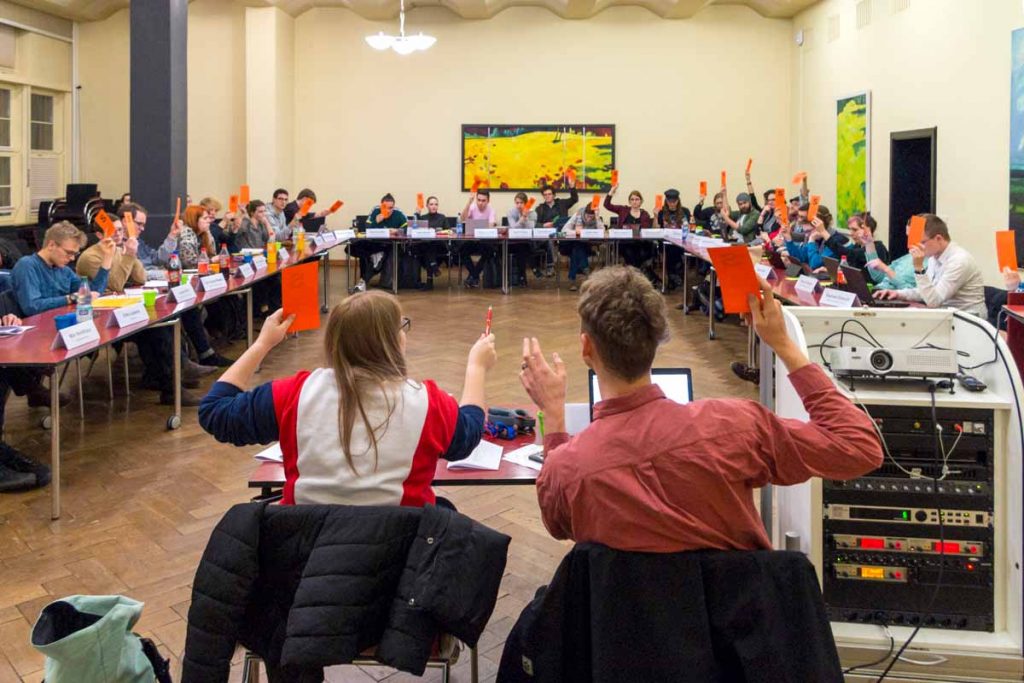
Photo: Paula Götze
The alleged “alternative” is mainly concerned with degrees and modules that focus on gender studies and postcolonialism, determining those fields to be purely ideological and refusing to acknowledge their scientific status. According to the “German Education Server”, all throughout Germany there are only five foundations and circa 20 research centers, institutes, and projects with a focus on gender and women’s studies. For postcolonial studies, only a handful of institutes, working groups, and networks exist. None of those are headquartered in Saxony-Anhalt. Thus, the amount of conducted research in those subjects is in no way proportionate to the output of all the other fields of study. Instead, the AfD would like to promote a new department for “population research”, with the aim to research the causes and effects of the “withering away of our people”. Apparently, it has escaped the party that the demographic change is already being discussed in academic settings, for example in areas like sociology and human geography.

Photo: Paolo Schubert (CC BY-SA 3.0)
Furthermore, they demand an increased focus on research surrounding Islam. The way they see it, the current approach is shackled by an uncritical political correctness bound by the guiding concept of a multicultural society, which to the AfD makes it unrealistic. They argue that this alleged issue is only solved by establishing a “State-Level Institute of Critical Islam Studies”. Surely said critical view will then also be applied to all the other religions? You shouldn’t hold your breath. This proves that the populists themselves can’t even comply with their constant demand for a “freedom from ideology”, leaving their statements to be nothing but hot air. As Christian Wulff said back in 2010: “Islam belongs in Germany” and a generalized mistrust, like the AfD imposes, flies in the face of reason.
Lastly, we have to discuss Radio Corax. While it is elaborated upon in the media chapter of the agenda, it does affect the MLU directly. The local radio station, partly funded by university students and offering a space to gather preprofessional experience and help realize students’ independent projects, should be eliminated entirely. A public funding of “anti-German” antifascists? What an impertinence! Coming from fascists, this is hardly a surprising take.
It’s Serious
The AfD’s development in recent years is nothing short of frightening. Like no other field, science stands for rationality over polarization. But this foundation, believed to be indestructible for such a long time, is starting to corrode, and this process didn’t start last night. We now witness how the rise of this party starts to chip away at pillars of our society many believed to be the end of history – at least since 1989, if not earlier. Hard-won progress starts to be doubted by relevant parts of our society, reliable institutions are in danger of being destroyed.
God knows, Berlin’s not Weimar. But are the words of the last Holocaust survivors not enough of a warning that such levels of hate, as embodied by the parliamentary arm of the alt-right, can only end in catastrophe? We know what happens, should we allow it free reign.
Universities are places of intellectual freedom and action. Teaching and learning can only occur where neither tutelage nor coercion restrict one’s work. It has to be one of the MLU’s core interests to guard itself against interference and hostile ideologies effectively. The university should be among the first when it comes to taking a stand for democracy and against the AfD.
Translation: Ellen Helmecke