
Dies ist die englische Übersetzung, lies den ursprünglichen Artikel hier!
More than half of our students are regularly confronted with their menstruation. Yet, the topic gets little attention in university life. How a project focused on menstrual products can offer relief, especially during the exam period.
The morning of the exam. Get up extra early so you don’t need to stress out. All thoughts are revolving around the exam, potential questions and the thick stack of index cards repeated last night. And that’s when it happens: abdominal cramps. Terrific.
The majority of students at our university menstruate once a month on average and have to deal with their period and its side effects not just in everyday life at the campus, but also during examination period and other academic achievements. Even beyond just the bleeding, these can be extensive. Aside from the aforementioned abdominal cramps, there are head- and backaches, nausea, dizziness, tiredness and mood swings, to name just a few. Creativity faces few limits in that regard.
While some go through their menstrual period with barely any symptoms, up to 90 percent of people affected report discomfort, 10 to 15 percent of them even suffer from endometriosis. Additionally, most menstruating people face mental and physical changes similar to the side effects of their period, even before it starts. PMS – premenstrual syndrome – is felt by 20 to 40 percent of menstruating people severe enough to impact their daily life. In particularly severe cases, it can even be a PMDD, or premenstrual dysphoric disorder, with the range of symptoms ranging from depression to bouts of suicidal ideation.
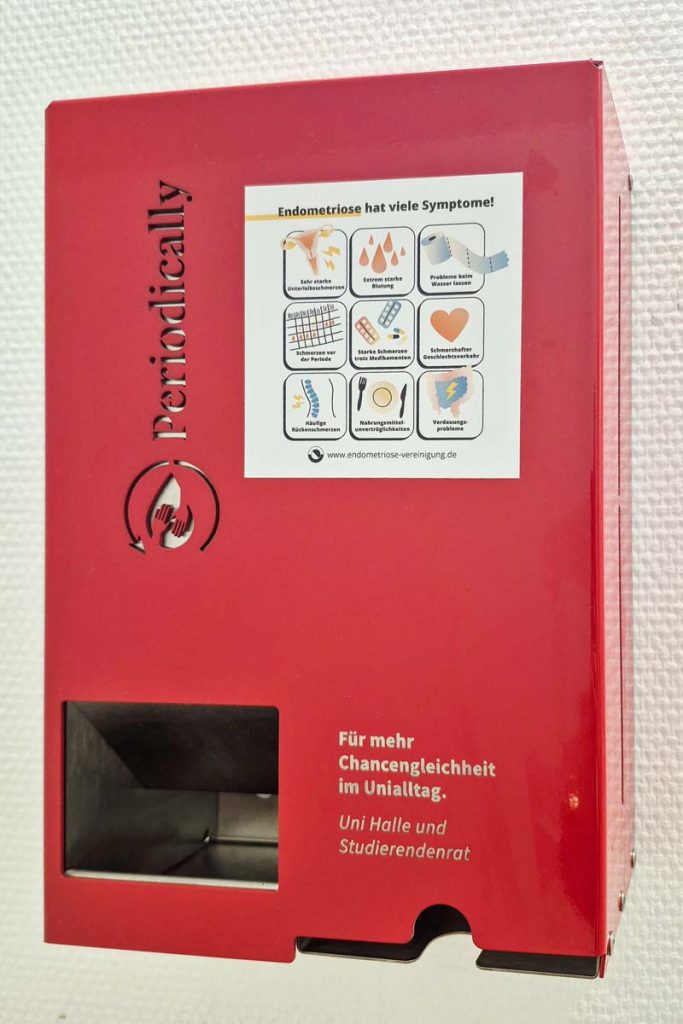
Photo: Franziska Ripke
| Endometriosis is one of the most common medical conditions of the lower body. Uterine tissue grows outside the womb, causing intense pain during menstruation and after sexual intercourse. In extreme cases it can even lead to infertility. For more information there is already an article in issue 97! |
The dispenser shall save us
Menstruation is, despite affecting more than half the students, hardly a subject in university politics and student life.
Students who regularly frequent the libraries have probably seen our savior before. A little red dispenser with tampons and pads has been installed by the university in various women’s and all-gender restrooms throughout the campuses.
The pilot project has been in place since December 2024, with the rectorate and Stura footing the bill. It is supposed to promote equal opportunities across university. Since December 2025 the necessity of those dispensers is under review. Via the Stura website you can participate in an evaluation.
While helpful in principle, the project shows some minor and major weaknesses, like any pilot project. More often than not, the dispensers are found empty and in most cases only in a single location on the campus. This can turn the trip to salvation and back to the lecture hall into a fifteen minute journey.
In a world where auntie still refers to “shark week”, the university is still taking steps towards equal rights with this promotion.
Dispenser locations
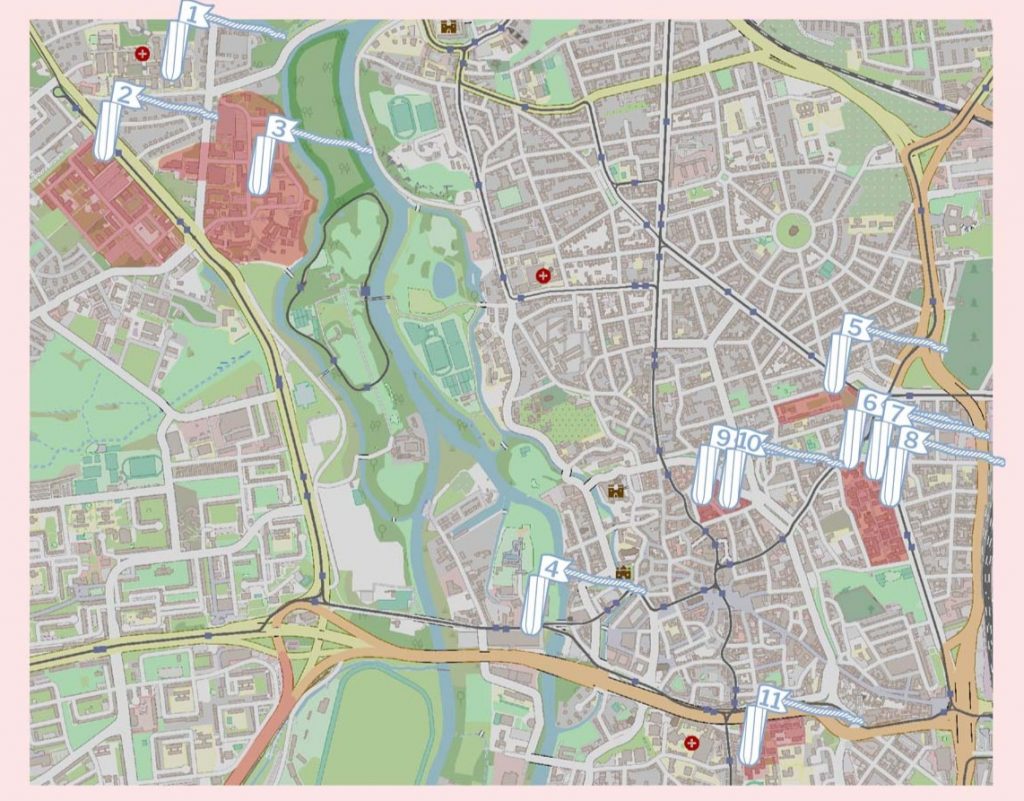
1 Uniklinikum, Funktionsgebäude 6 – Hörsäle, Ernst-Grube-Str. 40
2 Bibliothek Heide-Süd, All-Gender-WC (1. OG), Damen-WC (1. OG), Von-Danckelmann-Platz 1
3 Chemie, Damen-WC (EG), Kurt-Mothes-Str. 2
4 studiFIT Lührmann, Damen-WC (1. OG), Mansfelder Str. 15
5 Steintor-Bibliothek, All-Gender-WC (EG), Damen-WC (EG), Emil-Abderhalden-Str. 23
6 Anatomie und Zellbiologie, Große Steinstr. 52
7 Dekanat Medizin, Magdeburger Str. 8
8 Zahn‑, Mund- und Kieferheilkunde, Magdeburger Str. 16
9 Bibliothek Juridicum, Damen-WC (EG), Universitätsplatz 5
10 Audimax, All-Gender-WC (EG), Universitätsplatz 1
11 Bibliothek Haus 31, All-Gender-WC (EG), Damen-WC (EG), Franckeplatz 1
Map: Konrad Dieterich
Based on: OpenStreetMap (openstreetmap.org/copyright), made with MapOSMatic/OCitysMap on print.get-map.org, edited
Tips: Exams, despite cramps
In case your period catches up to you during exam season, here are some quick tips:
The weeks before the exam: during long days and nights at the library and an unannounced period or lacking menstruation hygiene products you can try the aforementioned dispensers. Also: Try to adjust your workload a little bit. Not every day will be equally productive. Plan for necessary rest days.
Immediately before the exam: In case you need to visit the restroom more than usual, it can be helpful to approach the examining personnel and talk to them if you feel comfortable with that. Especially in courses where exams can last more than three hours, one more trip to the restroom is usually unavoidable. Upon consultation with the examining personnel, you can also deposit an emergency kit with hygiene products by the toilets.
During the exam: alternative hygiene products often last longer. Products like a menstrual cup or disc in particular, catch more blood and don’t need to be changed as often. Remember to have enough to drink in arm’s reach. Sufficient hydration is proven to reduce problems like headaches and even cramps. A wrap-around heating pad or patch can bring some salvation. In case of emergency you can even take tried and true painkillers. But if you are uncertain, a trip to the pharmacy should help.
In case of endometriosis: If you are diagnosed with endometriosis, you can get a doctor’s note to excuse you from the exam. Even without a diagnosis, a doctor may determine you are unfit to take the exam.
In the end, there is really only one thing left to say: The menstruating body is, despite all adversity, an impressive system, that accomplishes much more than just studying. So if amidst learning schedules, exams and to-do-lists a break is necessary all of a sudden, that is not failure – it is a day where your own comfort takes precedent. And in all honesty: If you still manage to get through exam season, in spite of cramps, tiredness and mood swings, this should deserve some extra credit, and then some.
Translation: Vincent Kreuziger