
Dies ist die englische Übersetzung, lies den ursprünglichen Artikel hier!
By a clear margin, the Rot-Grüne Liste won the student council election – even if the total voter turnout was less than impressive. Students displayed their voter apathy on other university committees, too. Besides, the early election date may have stifled some ambitions.
With the longest lists of candidates, the highest number of poster designs, and the dopest reels, the joint slate of Jusos (Young Socialists) and Grüne Hochschulgruppe (Green campus group) left nothing to chance in their quest for success. Competing for 18 university-wide (“open”) seats in the student council, the Red-Greens had managed to mobilise 55 candidates. Thus, they broke last year’s record of 32 people sent in by the leftist Offene Linke Liste (OLLi). As a proportional electoral system applies, each vote for a person counts towards the whole slate.
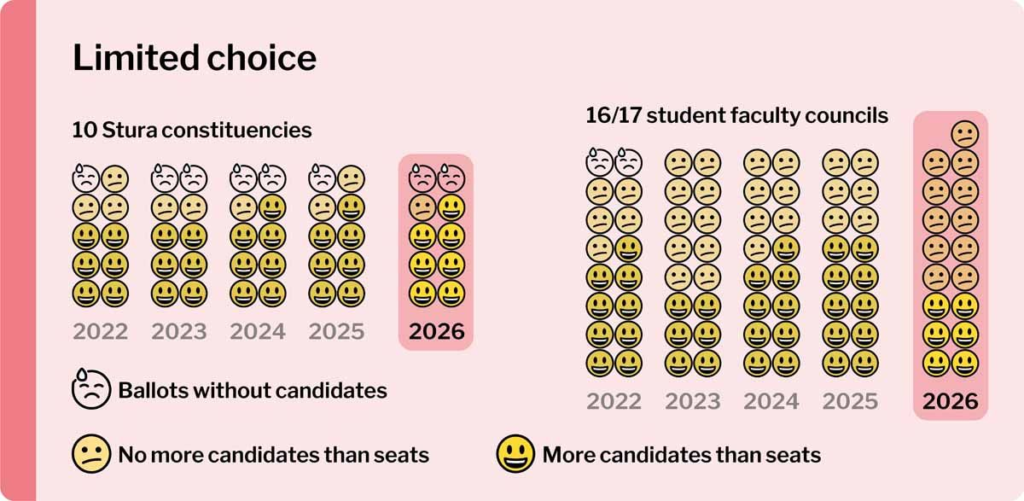
In the Studierendenrat (student council, or Stura for short) election, candidates can run simultaneously on a slate for the open seats and on one for the seats of the constituencies which roughly follow the faculty structure. The Rot-Grüne Liste made thorough use of this opportunity to further improve their electoral prospects. In the electoral division of medicine, the only two candidates on the ballot were theirs. With that, they were practically guaranteed to win those two seats. While the Offene Linke Liste also had two medical students among their ranks, these stood only for the open seats. Otherwise, however, most of OLLi’s open seats candidates also ran for their respective constituency.
Huh, what even is this Stura thing? What is it good for? And more importantly: can it go? A brief introduction.
https://hastuzeit.de/stura-basics/
The trade union list TVStud made things harder for themselves by having no presence in any of the electoral divisions. Nonetheless, on top of the two seats they won directly, they gained a third as one of their candidates moved up to fill the vacant seat from the Studienkolleg constituency.
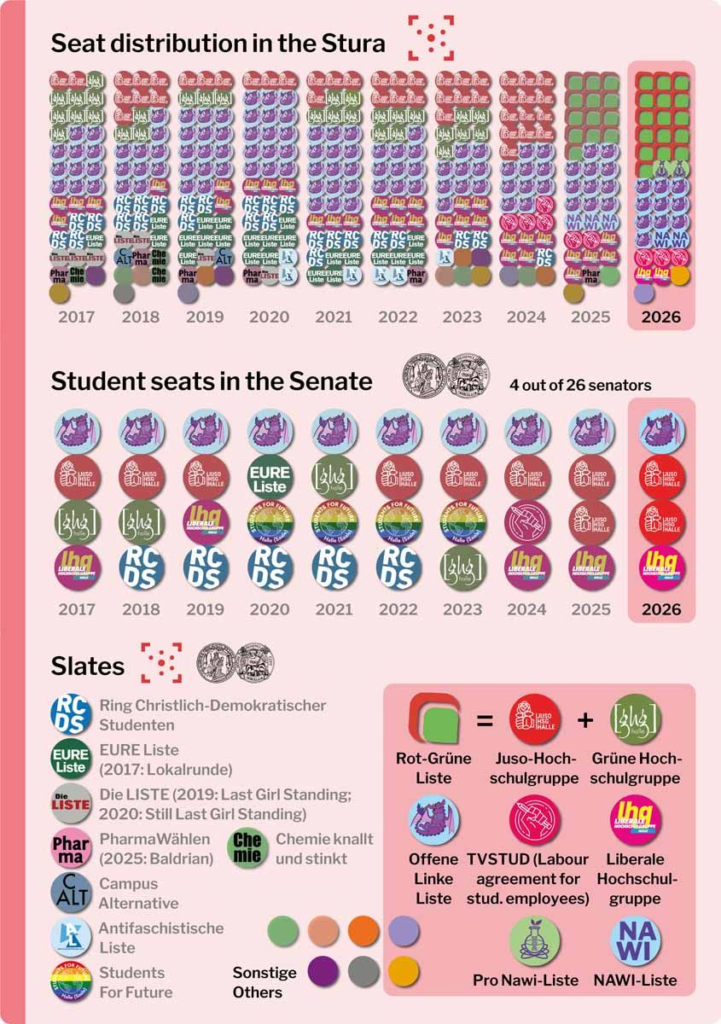
The strategy and commitment of the Rot-Grüne Liste paid off: according to the official results, they secured 16 out of 37 Stura seats. Another two seats went to the “Pro Nawi-Liste”, which appeared on the ballots of the three natural sciences constituencies in place of the Red-Greens. The acronym stands for Progressive Naturwissenschaften (progressive natural sciences) and may be understood as a response to the “NAWI-Liste”, which had already run last year in the natural sciences constituencies in lieu of OLLi. While both science offshoots positioned themselves a little different from the Red-Greens and OLLi on some issues in the Mahlowat online tool, the overlaps in personnel are obvious.
Regarding the “Pro Nawi-Liste” and other questions related to the election, hastuzeit approached both the Juso and Green campus groups twice for comment, but received no response. It remains unclear just how much Green there is in the joint Rot-Grüne Liste, to what the two campus groups attribute their success, and how they had managed to mobilise so many candidates. In this regard, it is noteworthy that 8 of the 16 elected Red-Greens (or 18, including the Pro Nawi-Liste) did not accept their mandate and left their seat to candidates further down the list. Meanwhile, only 3 out of 10 elected candidates for OLLi (or 12, if the NAWI-Liste is included) declined their seats, while the smaller groups, TVStud and Liberale Hochschulgruppe, have moved into the Stura as they were elected.
What the groups say
Even though OLLi has lost one seat compared to last year (or two, if you include the NAWI-Liste), in their response to hastuzeit they state that their result has them “all in all satisfied”. Their election campaign left them even happier: “We were the only group to show daily presence in front of the canteens, handing out information and seeking direct communication with students.” According to them, their main focus was on everyday issues such as exam stress, compulsory attendance, and the conditions of students in the workforce. “We would also like to acknowledge that this year’s campaign has been overall fair and square, and that the campus groups have refrained from any smear campaigns.” However, OLLi refused to answer any questions about both the NAWI-Liste and its competing Pro Nawi-Liste.
The union list TVStud is very pleased with their third seat and attributes their success to their work beyond the scope of the Stura. “Our campaign has had its peak in late 2025 / early 2026 during the TV‑L bargaining round. (Editor’s note: TV‑L means the collective agreement for employees of the states of Germany.) Instead of spouting empty rhetoric on Instagram and hanging posters, we had boots on the ground and stood with the students who have assistant jobs at the university, listened to their grievances, educated them about their labour rights, mobilised them for our TVStud campaign, and took to the streets to strike loudly on several occasions,” writes Anne Siebert.

Meanwhile, the Liberale Hochschulgruppe (Liberal campus group, LHG) has shrunk from five to two seats. They did not react to written inquiries from hastuzeit. Neither did the two students who have entered the student council in the constituency encompassing Agricultural and Nutritional Sciences, Geosciences and Geography, without being on any slate. As no one had proposed a list of candidates there, voters could enter the names of their favourites on the empty ballots.
By a small margin, the newly founded list “Theologians for social democracy and against antisemitism” (TfSDugA) missed out on a seat. They were the only group to acknowledge in their statement that the unusually early election date had caused problems. Pia Dobisch did not intend to stand as their only candidate. However, a fellow student failed to change his entry in the electoral register on time and was therefore ineligible to run in the constituency of Education and Theology. This year, the university had scheduled the election period particularly early to allow for enough lead time before the rectorial election in July. The rest of the schedule had to shift accordingly. Whoever wanted to have their voting area changed in the election register had to make it happen before 9 April at noon – no more than one and a half days after the start of the lecture period. On a brighter note, Pia has some appreciative words to add: “In my opinion, our Fachschaftsrat (student faculty council) of Theology, for their part, did a tremendous job of mobilising candidates.”
And then there is a campus group that did not even stand for election. After an extensive hiatus, the local chapter of the conservative Ring Christlich-Demokratischer Studenten (Association of Christian-Democrat Students, RCDS) reported back in late February on Instagram with a new committee. In April, they organised a talk on the situation in Iran and the Middle East. Their decision not to take part in the university elections had nothing to do with the early election date, they say. “That was of no concern to us. For now, we are still rebuilding and will be back next year with a big slate of candidates,” replies the committee of RCDS Halle.
Disappointing turnout
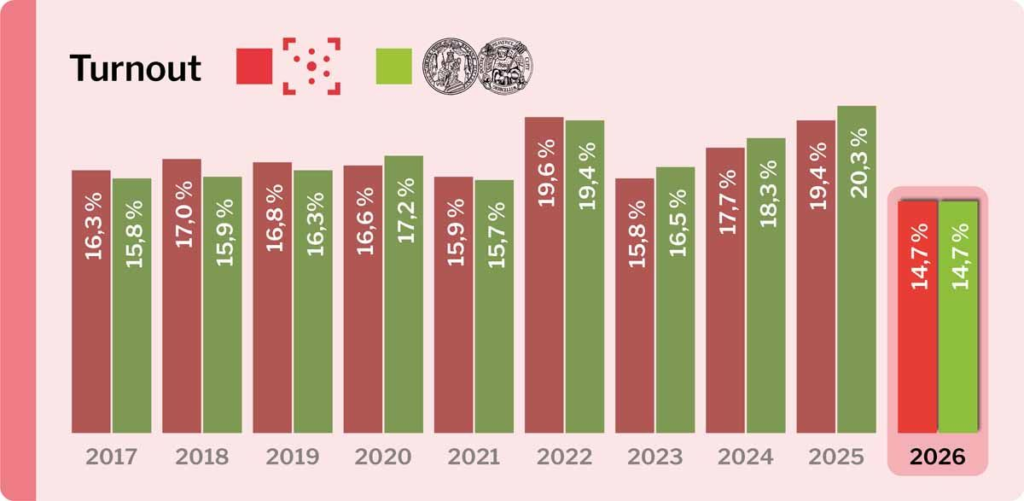
When 14.7 per cent of eligible student voters cast their ballots, that doesn’t sound impressive – and by MLU standards, it’s really not. After all, turnout exceeded 19 per cent in 2022 and 2025. Even so, Halle’s student body is still ahead of comparable mid-sized universities such as Jena or Leipzig, as turnout in both places has dropped as well. Not to mention the situation at larger universities. For example, the big three unis in Berlin regularly draw less than five per cent of their students to the polls.
It’s hard to pinpoint why this year’s turnout has remained below average. At any rate, there were no major controversial issues around – neither between the campus groups nor in the larger political space. Currently there are no plans to further cut university budgets, too. What did cause a bit of a stir was a motion by the opposition party AfD to abolish the Verfasste Studierendenschaften (legally codified student bodies), thus getting rid of the Studierendenräte (student councils) and Fachschaftsräte (student faculty councils). However, the Landtag (state parliament) clearly rejected this. Besides, no student referendum was called this year – for instance, regarding the transit pass for students. In previous years, these ballot questions may well have mobilised some voters for the committee elections held at the same time.
None of the answering campus groups are happy with the turnout. “We believe the Stura is not visible enough to students in terms of what the council has to offer to them”, writes Anne from TVStud. “And so, they don’t have a reason to vote.” Pia from TfSDugA thinks the turnout is “an absolute shame, to put it mildly,” especially “considering that we must fear for our student self-governance in case the AfD should win the September elections.” OLLi suspects: “Politically interested students might prefer committing themselves outside of the area of university politics. In order to achieve a higher turnout, it may help to start the campaign earlier, but it seems unclear how much of a difference this would really make.”
Meanwhile, RCDS, which didn’t stand for election this year but wants to “present a strong slate again in the future”, sees some entirely different reasons: “From our perspective, there is often a lack of issues and ideas that could motivate larger segments of the student body for political engagement. In addition, this year’s ballots featured almost exclusively left-wing and left-green options. When there are no mainstream conservative options on the ballots, which would also add some ‘friction’ with the competing options during the election campaign, these students as well as undecided voters just stay away from the polls.” states the Halle committee of the CDU-affiliated student association RCDS.
Unusual Senate election
It was a major election year for the MLU Senate: with the rectorial election coming up, not only students but all groups were called upon to vote in the university elections, including professors, academic staff, and other staff. But especially on the students’ ballots, lists were strikingly short this year. Again, the early election date may well have contributed to this: once the lecture period had started, interested students had just eleven days left to decide whether to stand, gather signatures from supporters of their nomination, and submit the forms.
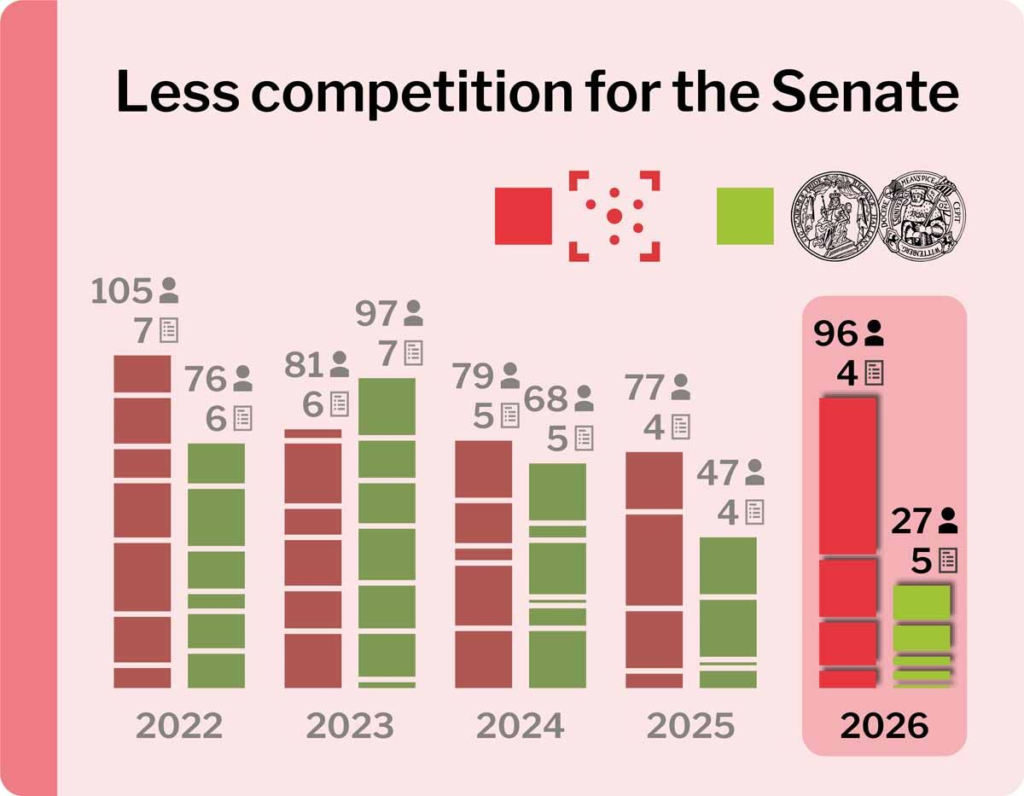
Nevertheless, a new entry appeared on this year’s student ballots under the slogan “Inclusion needs a voice in the Senate”. Its only candidate Dr. Christfried Rausch is already familiar with the inner workings of the university. In the 2010s he worked for the Senate’s disability officer and from 2020 to 2023 he was the consultant for inclusion in the rector’s office. As an independent candidate, he garnered more votes than the three TVStud candidates combined, but still failed to secure one of the four student seats in the Senate. hastuzeit would have liked to know in what way he is dissatisfied with the Senate’s approach to inclusion policy and how he intends to raise his concerns now without a seat in the committee. However, a request for comment remained unanswered.
Ultimately, the Jusos entered the Senate on two seats while OLLi and LHG each secured one. OLLi was less than pleased with this outcome. After all, they had garnered nearly three times as many votes as LHG and came relatively close behind the Jusos. It’s whispered that Christfried’s candidacy had caught them off guard, and that his focus on inclusion had drawn voters away primarily from OLLi. However, the numbers don’t really add up. In order for another leftist seat in the Senate to materialise, at least 57 per cent of “inclusion” voters would have needed to opt for OLLi instead, with the remainder being evenly split between the Jusos, LHG, and TVStud. The gap of a good 400 votes behind the Jusos can arguably be attributed to OLLi squandering some of their opportunities. They had entered the Senate election with just three candidates, whereas the Jusos, who came out on top, had fielded a slate of twelve people.
Doctoral student representation
Since 2022, doctoral candidates have been electing their own representative body every other year. This committee was established because doctoral students can belong to different groups. Some are considered students, others count as staff, while external candidates hold no membership status at the university at all. This year, candidates had come forward in only six of the nine faculties. Therefore, no election for the doctoral students’ representative body took place at the Faculty of Philosophy II and the Faculties of Natural Sciences I and II. This is still a step up from the situation two years ago, when candidates stood for election at no more than three faculties. Voter turnout can therefore be compared only to a certain degree. This year, 11.5 per cent of eligible doctoral students voted for their representatives. Two years ago, it was 15.8 per cent, whilst four years ago it was only 7.6 per cent.
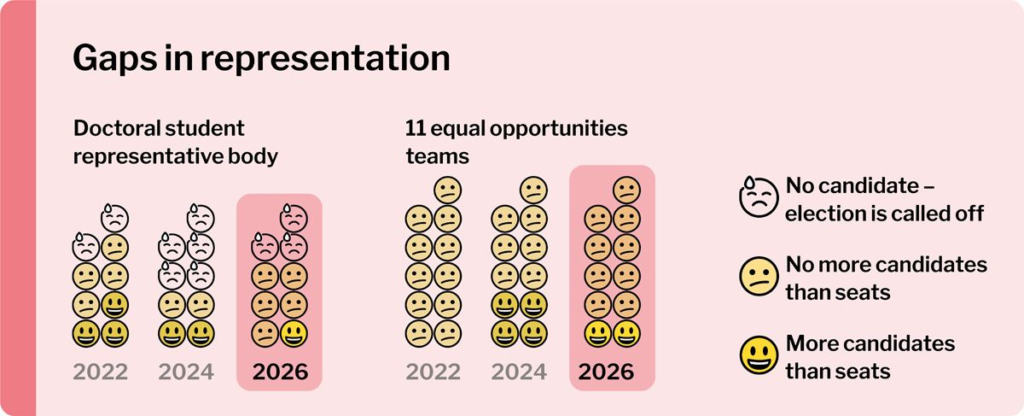
Similarly to the student faculty councils, the equal opportunity teams aim to enable everyone interested to participate. Voters only get a genuine choice if more than twelve candidates stand for a team.
Equal opportunities officers
Elections are also held every other year for the equal opportunities officers in charge of the university as a whole, of its central institutions, and of each faculty. They have the statutory mandate to promote equal opportunities for the female members of the university. For this purpose, they are involved in personnel matters, advocate for gender research, and contribute ideas, projects, and events. All students and staff members in the respective area may stand as candidates regardless of gender, but only women are eligible to vote.
Since 2022, the officers are no longer directly elected. Instead, voters cast their ballot for an electoral college of up to twelve members. These electoral colleges now view themselves more as “equal opportunities teams”, whose work is not over once they have elected their respective officer. All the team members in the respective area of the university remain available for contact on issues related to equity. However, only the elected equal opportunities officers can exert formal influence such as the right to vote or speak in committees and commissions.
With the equity teams, the workload has been spread across more people. This new structure allows for more committed people to get involved. Meanwhile, voters have become less important. Candidates with the most popular votes often end up not becoming the equal opportunities officer after all. When no more than twelve people stand as candidates in an area of the university, voters can’t even influence the composition of the team. This may be a reason why voter turnout dropped from 23.2 per cent in 2022 to 18.3 per cent in 2026. Then again, the numbers may simply be explained by voter apathy among students.
Translation: Konrad Dieterich