
Huh, what even is this Stura thing? What is it good for? And more importantly: can it go? A brief introduction.
The Stura of MLU (short for Studierendenrat, student council), is the body within the university tasked with representing the students’ interests — be it within the university, in the public, or elsewhere. Its members are elected on a yearly basis, with elections taking place each summer term. All representatives are students themselves — in fact, you can run for a seat in the Stura, too! The inaugural assembly follows shortly after the election. During this assembly, members run for positions such as chair, meeting leaders, and treasury. Once elected, they are called the spokespeople of their respective functions. In addition to student representatives, the Studierendenrat has a staff of four employees who are tasked with administration, digital matters, and public relations.
- Diesen Artikel auf Deutsch lesen: https://hastuzeit.de/stura-einmaleins

Montage: Konrad Dieterich
Providing advice and support is an important function of the Stura. For instance, it offers legal counselling regarding tenancy, contract, or labour related issues, free of charge. Students can also get advice on BAföG, the federal student grant programme for citizens and permanent residents. And should you find yourself in a financial emergency, the hardship fund can help. These loans have a ceiling of €1,500 per student in need and must be repaid without interest.
Alongside its spokespeople and employees, advisors fulfil another part of the Stura’s work. Their scope includes campus policy, higher education policy, social affairs, international students, sports, health, diversity, and events. Thereby, they take on some of the Stura’s workload.
Campus groups
Various Hochschulgruppen (campus groups) are represented in the Stura, some of which can be described as partisan. For instance, the Juso-Hochschulgruppe (Juso-HSG) is linked to the SPD (Social Democrats), the Liberale Hochschulgruppe (LHG) is affiliated with the FDP (Free Democrats) and the Offene Linke Liste (OLLi) is close to Die Linke (Democratic Socialists). Furthermore, there is the union list TVStud (demanding a labour agreement and co-determination for student employees), and the Grüne Hochschulgruppe (GHG) which is linked to Die Grünen (The Greens). The political campus landscape also includes discipline-specific student representatives, such as a pharmacy group and, formerly, a chemistry group. Some campus groups are no longer present in the Stura, such as the Ring Christlich-Demokratischer Studenten (RCDS), which is affiliated with the CDU (Christian Democrats), and the climate list Students for Future.
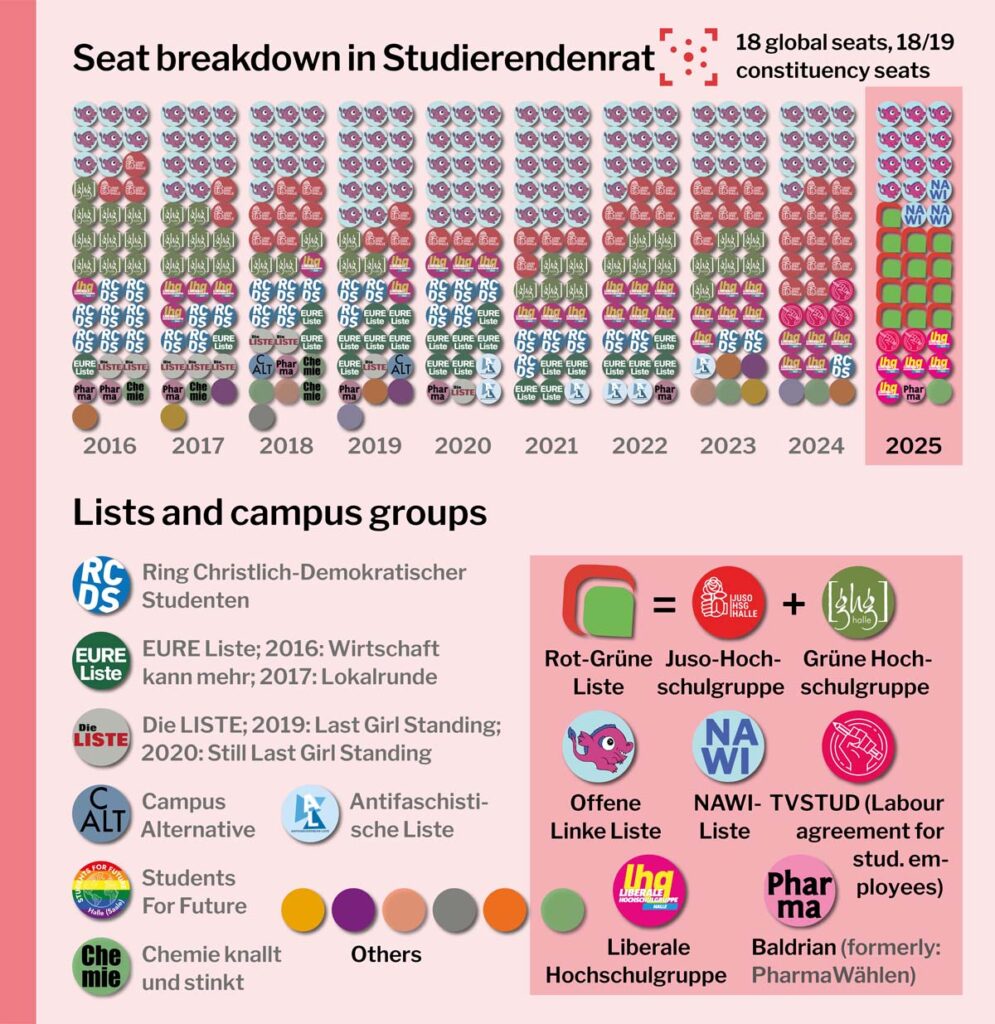
Working groups and projects
By now, 14 AKs (short for Arbeitskreise, working groups) have formed within the Stura. Their fields of activity range from “studying with children” to an AK “against antisemitism”. Their aims are quite similar: they all aspire to provide aid, support, information, and raise awareness for their respective fields.
The Stura doesn’t just organise election parties for themselves, but also the annual club tour, until recently a campus open-air festival, and supports many other celebrations and events.
Additionally, every MLU student can apply for the Stura’s project fund: be it a play, a workshop or a brochure — the Stura can help you turn your ideas into reality.
- An overview of the Stura’s services can be found here (German only): https://www.stura.uni-halle.de/#services
Who pays for it?
In short: us! (Almost) all students pay their membership fee for the student body together with their semester fees. It currently amounts to €12.35 and will increase to €16.50 from the 2026 summer term onwards. This money funds all expenses, from employees and compensations to hardship loans and other projects. Furthermore, the fee finances the student radio programme at Radio Corax and the student magazine hastuzeit, eachwith €0.50 per student.
Can it go?
While the Stura does struggle for visibility and is fraught with other problems and conflicts, it still generates added value and provides assistance and support where other university committees and state agencies fail to act. Especially when it’s about study-related obstacles — like when dealing with the certificate of incapacity for exams or an inclusive learning and support plan — you can contact the Stura or its office for help.
- If you would like to learn more about the Stura, university politics and its peculiarities, take a look here (German only): https://www.stura.uni-halle.de/hochschulpolitik-how-to/ (There is even a glossary!)
Translation: Konrad Dieterich