
Dies ist die englische Übersetzung, lies den ursprünglichen Artikel hier!
The fastest way to travel through Halle is often by bike. It’s also not without its dangers. For World Bicycle Day, the ADFC and Fridays for Future organized a cycling protest meant to raise awareness about the problems cyclists face in the city.
Tredder, iron pony, boneshaker – over time, the bicycle has garnered quite a few strange nicknames. But whatever you might call it, biking is sustainable, flexible, cheap and healthy – as long as you don’t get into an accident. It’s also gaining popularity. According to the industry, bike-leasing has more than quadrupled within the past six years. Today, over two million company bikes can be found on Germany’s streets. Between 2020 and 2025, the ADFC Halle-Saalekreis (German Cyclists Association for Halle and the surrounding county) saw its number of registered memberships doubled. While this does not outright prove a rising number of cyclists, it is still a strong indicator for an upwards trend. It also shows that people have become more aware of the problems associated with cycling.
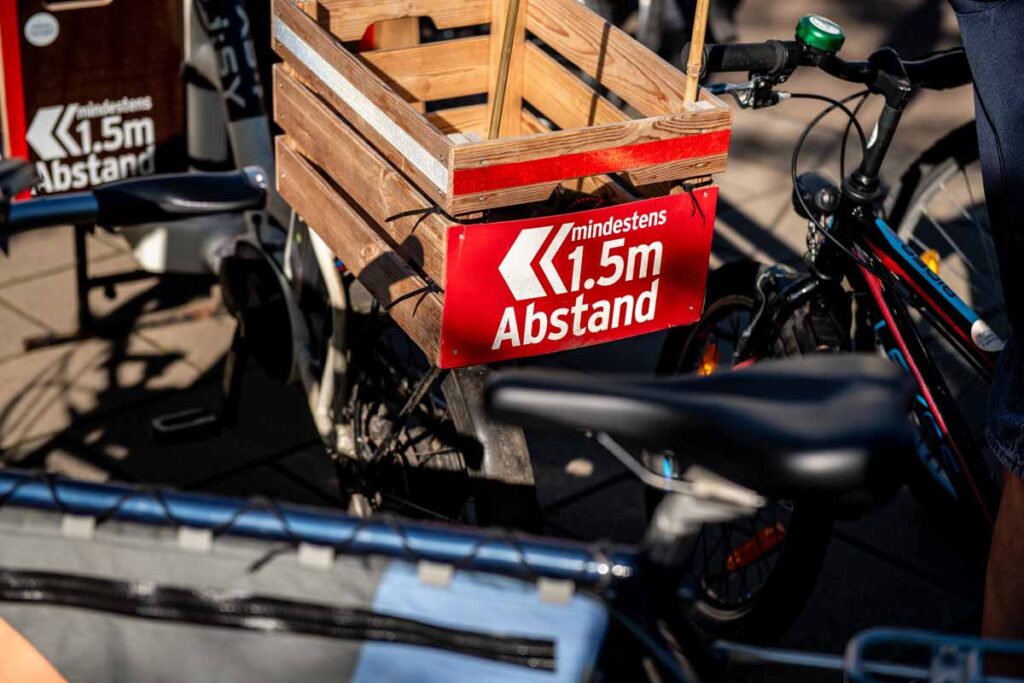
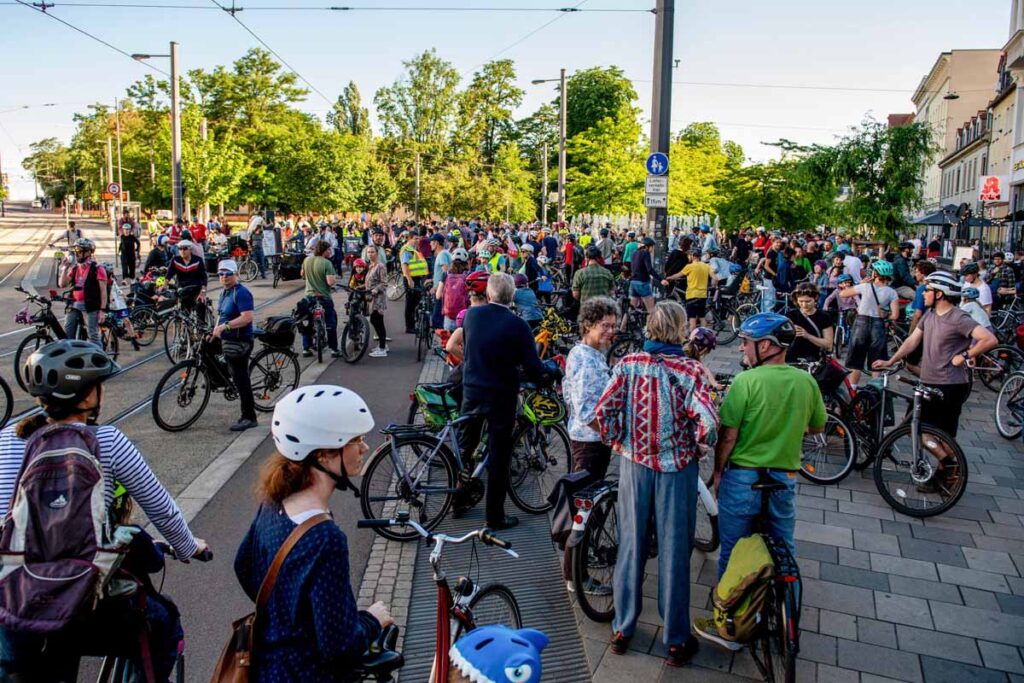
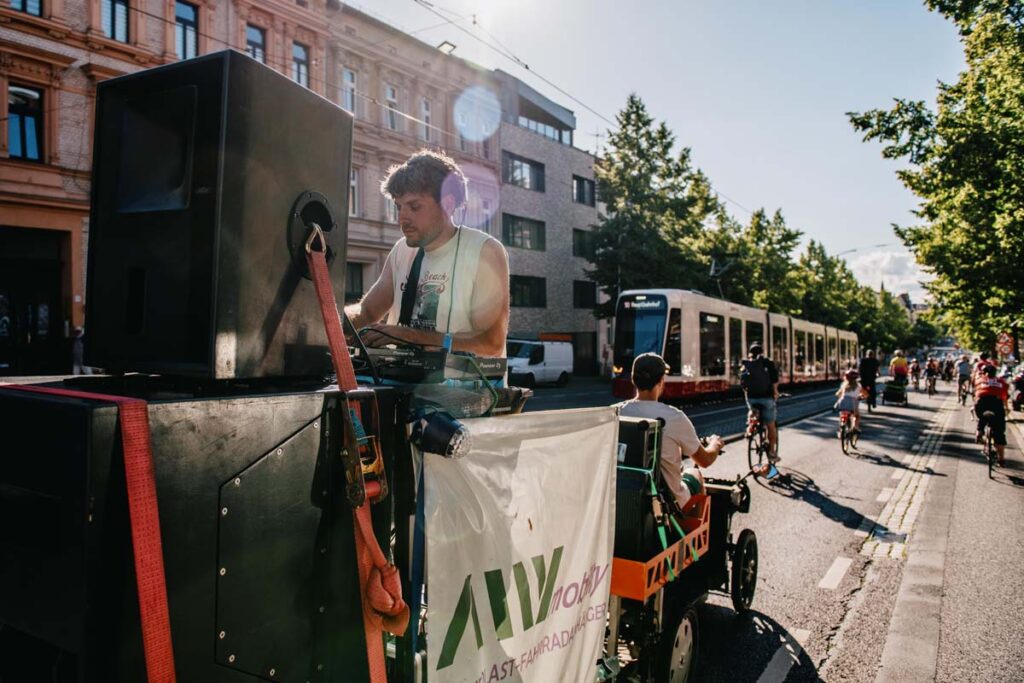
Upwards of a thousand bicycles were taken to the streets by their riders on Friday, June 5th. Two days prior, on June 3rd, it was World Bicycle Day. The AFDC and Fridays for Future Halle had cooperated in the organization of a cycling protest in Halles city centre. With ringing bells, music, and banners the protesters emphasized the importance of bicycles for a livable city. While cycling is trending, the statistics and reports of the ADFC as well as the police department paint a bleak picture: Cycling on Halle’s streets remains dangerous and there’s a considerable backlog in improving the necessary infrastructure.
The Development of accident rates
From 2017 to 2021 the annual number of accidents which led to injury and involved at least one bike stayed fairly stable at around 300. Starting in 2022, however, with 346 registered incidents, that number has started to climb. In 2023 there were 400 and 2024 counted 426 accidents. In 2025 the accident rate registered another significant jump – according to the news blog dubisthalle, Halles police counted 571 accidents with bicycles involved, with 395 people sustaining slight injuries and another 60 ending up severely injured. Furthermore, two cyclists lost their lives on Halle’s streets last year.
Most accidents occur without any outside involvement. Here, cyclists fall due to wet conditions or by getting caught on a curb, to name a few examples. If other road users are involved, cars become the most dangerous factor. In 2025 alone, they were the main cause in 167 of the accidents, mainly by ignoring the others’ right of way or through sudden, careless opening of car doors obstructing bike paths (“dooring”).
Conflict Hot Spots and Troubling Infrastructure
The demonstrations route, 15 kilometres long, was specifically planned to show off as many problematic areas as possible; starting with the Ludwig-Wucherer-Straße, which does possess bike paths, however those are both so narrow and damaged that cyclists are also allowed to bike on the road. The same situation also plagues the Damaschkestraße, but in this case, many drivers are not aware of this, leading to many dicey situations. Here, the ADFC calls for clearer communication, for example through additional signage and road markings. But many other areas are criticized as well, like Riebeckplatz or the Reilstraße, where bike paths end seemingly out of nowhere. Not to mention the traffic lights with overly long wait times and intersections with difficult and confusing traffic routing tempting illegal cycling behaviour.
But the places where cars and bikes clash often are not the only problem children in town: Halle’s tram system poses another worthy adversary for the everyday cyclist. The bike protest also traversed the Hallmarkt and Marktplatz and went along Große Steinstraße, which connects the Marktplatz with the Steintor. There, the tracks are not running parallel to the road, like it’s the case in Reilstraße and Ludwig-Wucherer-Straße, but instead are embedded right in the pavement. Therefore, it often comes to accidents in which the wheels of bicycles are caught in them, which can then lead to falls and injuries.
ADFC Halle-Saalekreis
The website of the German cyclists association’s regional chapter is available in German only.
The budgetary gap of the transport transition
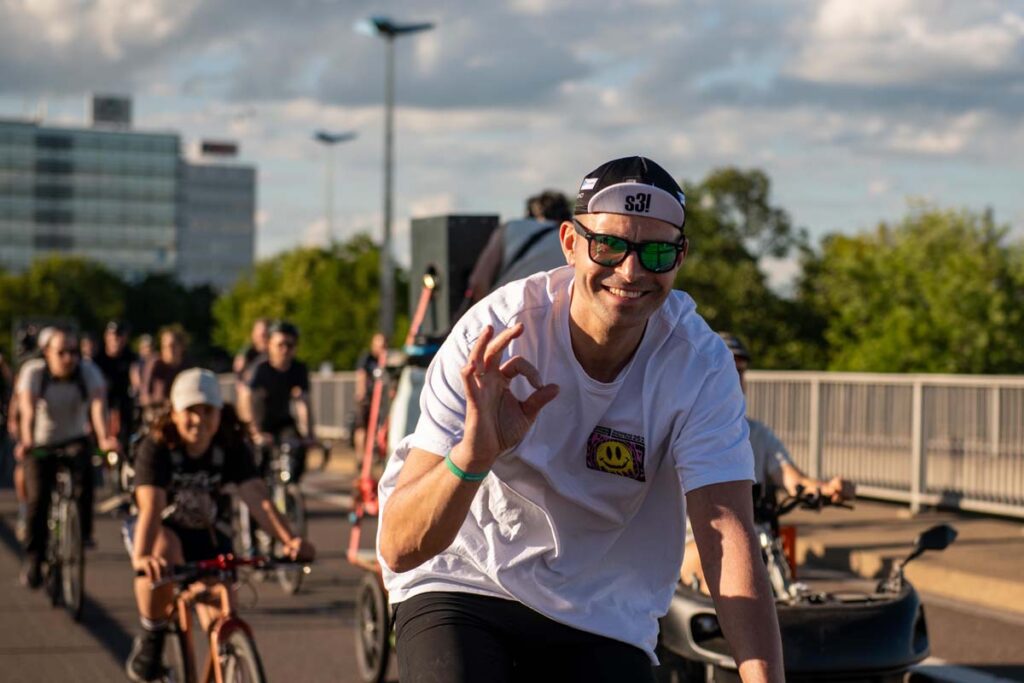
Political representatives from the local and state level were also present; namely Sebastian Striegel, member of the state parliament for the Greens, and Hendrik Lange, who is part of both the municipal council and the state parliament for the Left. Together with the protestors, they loudly demanded a fair distribution of public space, improved traffic light settings, to restore damaged bike paths, increasing the number 30 kph zones, and to solve conflict-ridden spots.
Theoretically, the money for these changes has been available since April 2024, when money was first allocated to Halle’s Holistic Mobility Concept. Titled “Mobility 2040+”, it’s meant to realize the transport transition in Halle before we reach the year 2040. In 2026, the allocated budget rose to three million Euro annually.
Unfortunately, the gap between theory and reality is enormous: the allocated budget for 2026 for building and upkeeping bike paths in Halle is a whole zero Euro. Meanwhile, the city has access to a special investment fund of 126 million Euro. The multi-story bike park at Halle main station, which has been stuck in the planning phase for over two decades now, will have to go another year without funding. The reconstruction of the damaged and inadequate bike paths like in the Ludwig-Wucherer‑, Damaschke‑, and Reilstraße keeps being pushed back with reference to budgetary constraints.
While many departments are fighting for the limited resources of the special investment fund, the bike protest raised the question if a future-proof mobility concept might be deserving of becoming a priority – especially in a university town like Halle.
Translation: Christian Ehrenfels, Ellen Helmecke