
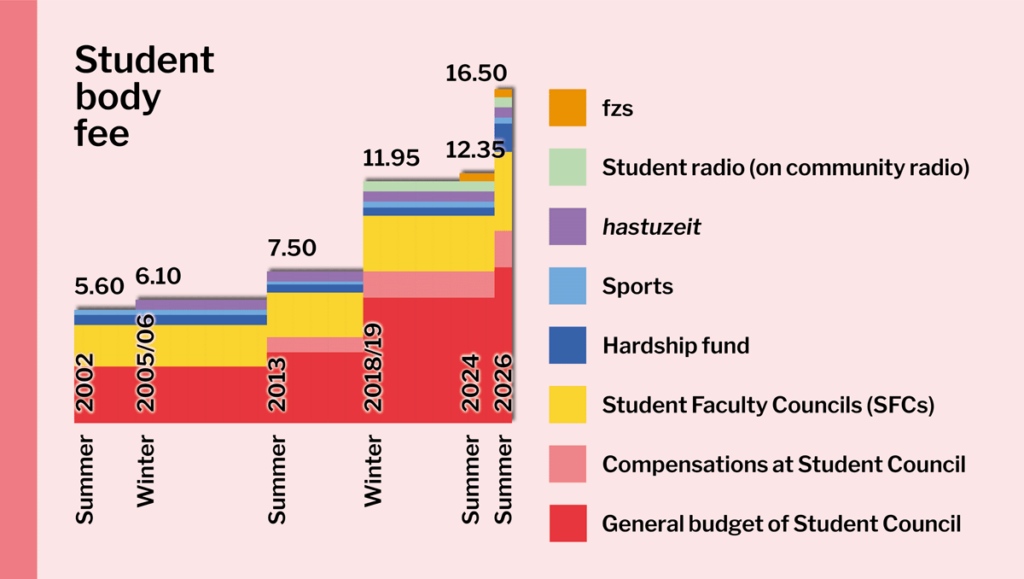
At the end of July, after debating back and forth, the student council has decided to raise the student body fee from €12.35 to €16.50. That’s less money in the students’ pockets, but maybe it’s a good deal after all?
The student body’s membership fee mostly consists of a share for the Studierendenrat (student council, or Stura) including its working groups and projects, and another share for the Fachschaftsräte (student faculty councils). The last markup came in the summer term of 2024, when MLU’s student body became a full member of FZS (freier zusammenschluss von student*innenschaften), a national umbrella association of student representative bodies. The new raise of the student body’s membership fee will take effect in the summer term of 2026.
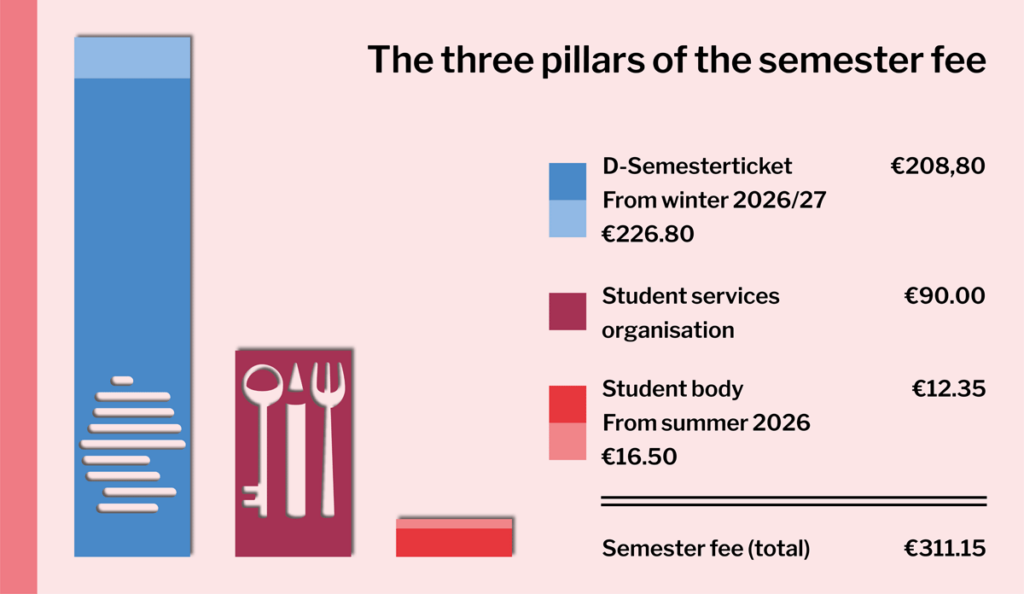
This membership fee is part of the semester fee — alongside €90 for the Studentenwerk (student services organisation) and the D‑Semesterticket (nationwide local public transport pass), the latter making up the lion’s share with €208.80 — as of the current term.
A long-winded compromise
Ever since the budget debate in November 2024, the issue of raising the fee had been on the table. However, more substantial deliberations didn’t pick up momentum until campus elections were around the corner. While some talks had already been held, these were reportedly not well coordinated. For instance, many of the Fachschaftsräte complained they had been left out of the discussion.
At the 18th meeting of the 35th Stura, during the height of the campus election campaign, the Offene Linke Liste (Open Leftist List, OLLi) finally submitted a proposal. According to the minutes of the meeting, the Juso-HSG (Young Socialist campus group) had already set the target sum at €16.50 — but was still working on a more specific plan as to how it should be divided. In total, these propositions were only apart by a few cents. Some attending members of Fachschaftsräte urged the Stura to find a compromise. However, it became clear that no agreement would be reached at this point in time. Another evening passed without any changes to the fee.
One month later, the 35th Stura had to assemble one last time due to a partial election rerun. Now, at the end of the campaign, they came to an agreement after all, maxing out the limit of €16,50 as previously demanded by the Juso-HSG.
What’s in it?
Firstly, the Fachschaftsräte have got their increase. Instead of €2.75 per student they now receive €3.90. The general budget of the Stura increased by €1.50, to a total of €7.70. Considerably more money will be put in the hardship fund, too: €1.40 instead of the current €0.40. Furthermore, funding of compensations will increase by 50 cent and amount to €1,80. New financial regulations stipulate reducing the hourly rate of compensationss from €8.06 to €7.50.
In recent years, this hourly rate had repeatedly increased as it was tied to the rates of BAföG, the federal grant to students in Germany. However, the Stura had failed to raise the corresponding item of expenditure in their budget accordingly. That is why the budget item earmarked for allowances will grow even though the rates have been curtailed.
Critical words
Of course, the student body’s membership fee accounts for a mere fraction of the total semester fee. The price hike of the Deutschlandticket is much more of a drain. Nevertheless, it is worth taking a closer look at where our money is flowing.
With more resources in its hardship fund, the Stura should be able to help out more students in financial emergencies. These loans cap out at €1500 per person and repayments are interest-free. Still, these are not always honoured and in some cases the student body is stuck with the expenses. Besides, while these emergency loans serve a good and important purpose, they only address the symptoms of a bigger issue. For instance, if you depend on BAföG payments and they just don’t come, but the rent and all that jazz is still due, an emergency loan can save you in the nick of time. And yet, the blame lies with the broken BAföG system.
Some Fachschaftsräte had already criticised the allowances paid out within the Stura. Now this budget will increase while the hourly rate will be marked down. We have sent a press inquiry to all campus groups in the Stura and only the Liberale Hochschulgruppe (Liberal campus group) has responded. In their statement, they write: “This [larger budget for allowances] is out of all proportion to what the students actually get in return from the Stura.” They believe that hardly anybody knows what the Stura is doing and how it improves the lives of students. This low visibility has been an issue for a long time, but doesn’t delegitimise allowances per se. Besides, spokespeople are remunerated for just 50 percent of their working hours.
More money in the general budget also means more resources for supporting external projects. However, with its current budget, the student council had quickly reached a point where the project funding earmarked for the first half of the year was nearly used up. Therefore, later projects received considerably less money than what they had initially applied for. There was a noticeable trend: At the beginning of the term — with a full project fund — councillors tended to look less closely at the proposals and were less concerned with how much these projects would benefit the student body or how many students they could reach. Once the money has become scarce, the council pulls out their magnifying glasses to look for potential savings. Therefore, standards and requirements were not the same for all applicants. A somewhat larger project fund won’t change this. However, the student council did strive to fund as many projects as it could despite its limited budget.
Stress test coming up
It won’t be the last time that the semester fee increases. After all, a stable price for the Deutschlandticket is by no means certain. Another challenge is already approaching: Membership in the FZS currently amounts to 40 cents of the student body fee. However, they consider an increase that demands a response: one of the possible outcomes could be a further raise of the student body fee beyond €16.50. After all, the majority of the Stura had recently voted to remain in the FZS and rejected the withdrawal proposed by the Liberale Hochschulgruppe. In any case this will be yet another stress test for the student council.
Translation: Konrad Dieterich